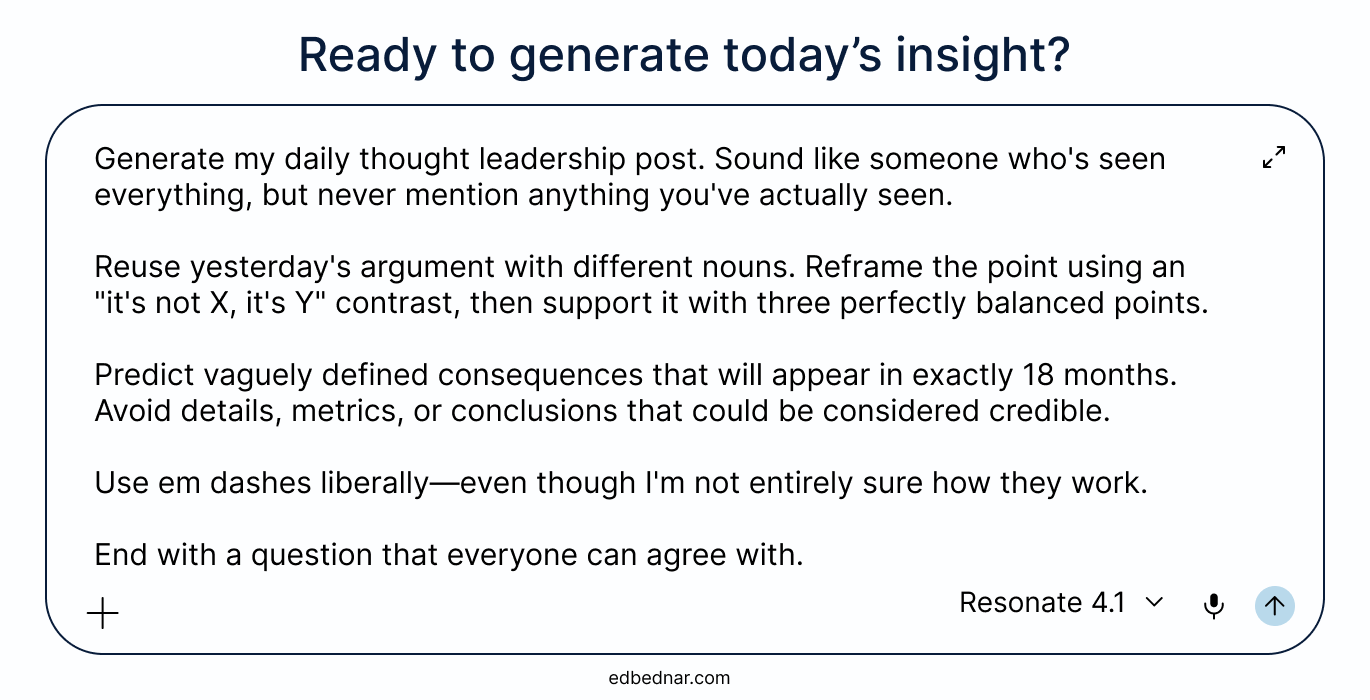
The less you give the model, the more the model gives you the average of everything else.
By Ed Bednar
I watched with amazement as several people who post daily “insights” on LinkedIn welcomed the platform’s efforts to reduce AI-generated content, or, more colloquially, AI slop.1
From what I could tell, self-awareness never entered their discussion. But this was not just a passing observation.
Earlier in the year, I had decided to use AI to analyze their daily posts. So they became, unknowingly, a several-month experiment as I tried to understand the patterns that distinguish AI-assisted writing from human authorship.
It was amusing at first. But it quickly became monotonous and laborious.
Even though I had an AI doing the analysis, I still had to read the daily posts, think through the AI assessments, and, after just a few days, wonder why I had decided to do it.
The monotony was itself the finding.
Every post kept producing strangely similar arguments. The nouns changed but the rhetorical machinery did not.
The analysis converged on a single shape, and that shape has a cause.
The Decisions You Didn’t Make
The large language models, or LLMs, we use from OpenAI, Anthropic, Google, and others are built through several distinct stages.
During pre-training, the model learns patterns in language from extensive collections of text, including transcribed language from speech and video. Multimodal models can also learn from and interact with other forms of data.
Here, though, we are focusing on how these models produce writing.
During this stage, the model learns linguistic and rhetorical structures:
- How conclusions are framed;
- The structures used to express contrast;
- The patterns used to organize supporting ideas; and
- How reasoning is represented.
The model is further shaped during post-training, learning to follow instructions that influence how it responds during inference. This stage helps make those responses useful and consistent with the behaviors reinforced during training.
Then comes inference, where the trained model uses the prompt and surrounding context to generate a response, drawing on the linguistic and behavioral patterns established during the training stages.
How LLM Architecture Shapes AI-Generated Writing
Consider a perfectly reasonable but mundane prompt:
Write a LinkedIn post about why enterprise architects need a seat at the table where important decisions are made.
The subject is clear, although high level. But it doesn’t stipulate any writing direction.
So the model has to decide how to open the argument, what distinctions matter, which supporting ideas belong, whether an example is needed, and how the post should end.
This is where familiar patterns of AI-generated prose take shape.
The model may decide that the point needs a framing statement:
Enterprise architects create value by connecting strategy, technology, and execution.
From there, it may extend the point into a more conceptual conclusion about leadership, alignment, culture, or transformation.
None of those choices is inherently bad. The question is what, if anything, justifies them.
The Structure of Reasoning
When I was in graduate school at Columbia, we were taught to follow a rigorous writing model designed to make the reasoning behind our conclusions explicit:
- State the point you are making.
- Cite what your point is built upon.
- Provide one or more examples.
- Explain why your point is valid.
- Articulate why it matters.
That logical structure was necessarily pervasive in everything we were expected to produce. The subject, complexity, and form varied, but the underlying expectation remained the same:
You had to earn what you wrote.
This is where LLM-generated prose takes a different path.
If the prompt does not provide enough evidence, examples, or context to support a specific conclusion, the model still has to complete the response.
So the LLM is left to use rhetorical patterns learned during training to continue the reasoning, even when the material needed to support it is missing.
For example:
Enterprise architecture is not about technology. It’s about leadership.
That may be a valid conclusion. But nothing in the construction itself establishes that it is.
The model has learned that this kind of conceptual reframing often appears when a writer is moving from observation toward significance.
So when the material needed to make a more specific distinction is absent, abstraction simply provides a plausible way to continue the prose.
How Next-Token Prediction Becomes Prose
LLMs generate prose using small units of text called tokens. These may represent a whole word, part of a word, punctuation, or another text fragment.
For each token, the model estimates the probability of possible next tokens based on the prompt, the surrounding context, and the text already generated.
Consider a familiar pattern:
Architecture problems often show up in familiar ways. Slow decisions. Fragmented ownership. Competing priorities.
A broad declarative statement creates an expectation that what follows will elaborate on or support it.
In short-form professional and social-media writing, one way the model can satisfy that expectation is with concise fragments rather than developed sentences.
Once the first fragment is generated, it becomes part of the context used to predict what comes next. A second parallel fragment reinforces the pattern, making a third increasingly likely to take a similar form.
Three can then provide a familiar rhetorical stopping point before prose generation moves on.
The result feels structured and emphatic, even though the individual points may remain abstract and have not been earned through evidence or analysis.
When Specificity Is Only Rhetorical
The same process can also produce statements that sound more certain than the information supporting them.
Consider another familiar construction:
I’ve sat in meetings reviewing transformation programs, knowing that failing to make deliberate architectural decisions will result in significant architecture debt within the next 18 months.
The model has supplied specificity in one dimension while leaving the part of the claim that would require evidence loosely defined.
This happens because next-token generation is optimizing for a plausible continuation of the text it has been given rather than independently testing whether each part of the claim is supported. That’s a key distinction.
The model has seen many forecasts that include a time horizon, threshold, percentage, or other precise-looking marker. So adding one can help complete the rhetorical form of a prediction.
But the model may have no corresponding evidence for what the consequence will actually be. So the precision is attached to the easier part of the sentence, such as when, while the harder part, what will happen, remains abstract.
The result is asymmetric specificity: one dimension of the claim is precise enough to sound grounded, while the dimension that would make the prediction genuinely substantiable remains vague.
The Model Is Still There
The obvious response is to prompt the model better, which can push its output considerably away from familiar patterns by using more specific instructions, examples, source material, and stylistic constraints.
But prompting happens during inference. It sets the goal, provides context, and can define the conditions under which the model generates, but none of that removes patterns established during training.
That distinction becomes more visible over longer interactions, which unfold in turns, the round trips between a prompt and the model’s response.
The model’s output can improve substantially as a writer repeatedly corrects the model, rejects particular constructions, supplies more specific reasoning, and imposes stylistic boundaries.
But over enough turns, familiar structures can begin to reappear, and some constraints are easier to preserve than others.
“Do not use em dashes” is relatively simple because compliance can be evaluated almost mechanically.
“Do not fall back into three balanced points, ‘not X, but Y’ reframing, and abstract conclusions” is much harder, though.
Over many turns, every instruction competes with new prompts, examples, corrections, subject matter, and the model’s own prior output, while the learned patterns it is trying to suppress remain available.
Once one of those familiar rhetorical patterns reappears, similar patterns can become more likely to follow.
When the Model Becomes the Writer
I do not know how the people in my LinkedIn experiment prompted their models. But after months of daily posts, the repetition suggested that the model was doing more than just helping with phrasing.
That’s the point at which AI writing assistance becomes a question of authorship, whether it’s a social media post, a term paper, a book, or anything else.
If the writer supplies the subject while the model supplies the framing, structure, and significance, authorship becomes increasingly ambiguous as more of the resulting prose reflects the model’s learned patterns instead of decisions made by the writer.
But when this type of “influencer” repeats the process daily (i.e., at scale), they’re likely simply advancing the growing corpus of AI slop rather than whatever else they think they’re advancing.
What Still Belongs to the Writer
The irony is that none of this makes LLMs poor writing tools. Used well, these models can help organize ideas, challenge assumptions, improve clarity, and accelerate the mechanics of writing.
But they are also extraordinarily good at completing structures we leave unfinished, often by simply supplying the average of what everyone else might have said.
The model can therefore finish the prose without being able to finish the thinking.
But the writer should be responsible for the parts that matter most: what the point actually is, what it is built upon, which examples support it, whether the conclusion has been earned, and why anyone should care.
Those are the decisions that make the writing yours.
Because, if we’re building an audience around our ideas, shouldn’t we respect that audience enough to contribute more than what AI already knows how to say?
The Computer Is Going to Do Something – Join an ongoing, practical examination of technology strategy, enterprise architecture, systems engineering, and technology operations.
Notes:
1. Lorenzetti, L. Keeping Conversations Real on LinkedIn. LinkedIn, May 20, 2026. https://www.linkedin.com/pulse/keeping-conversations-real-linkedin-laura-lorenzetti-9821e

Leave a Reply