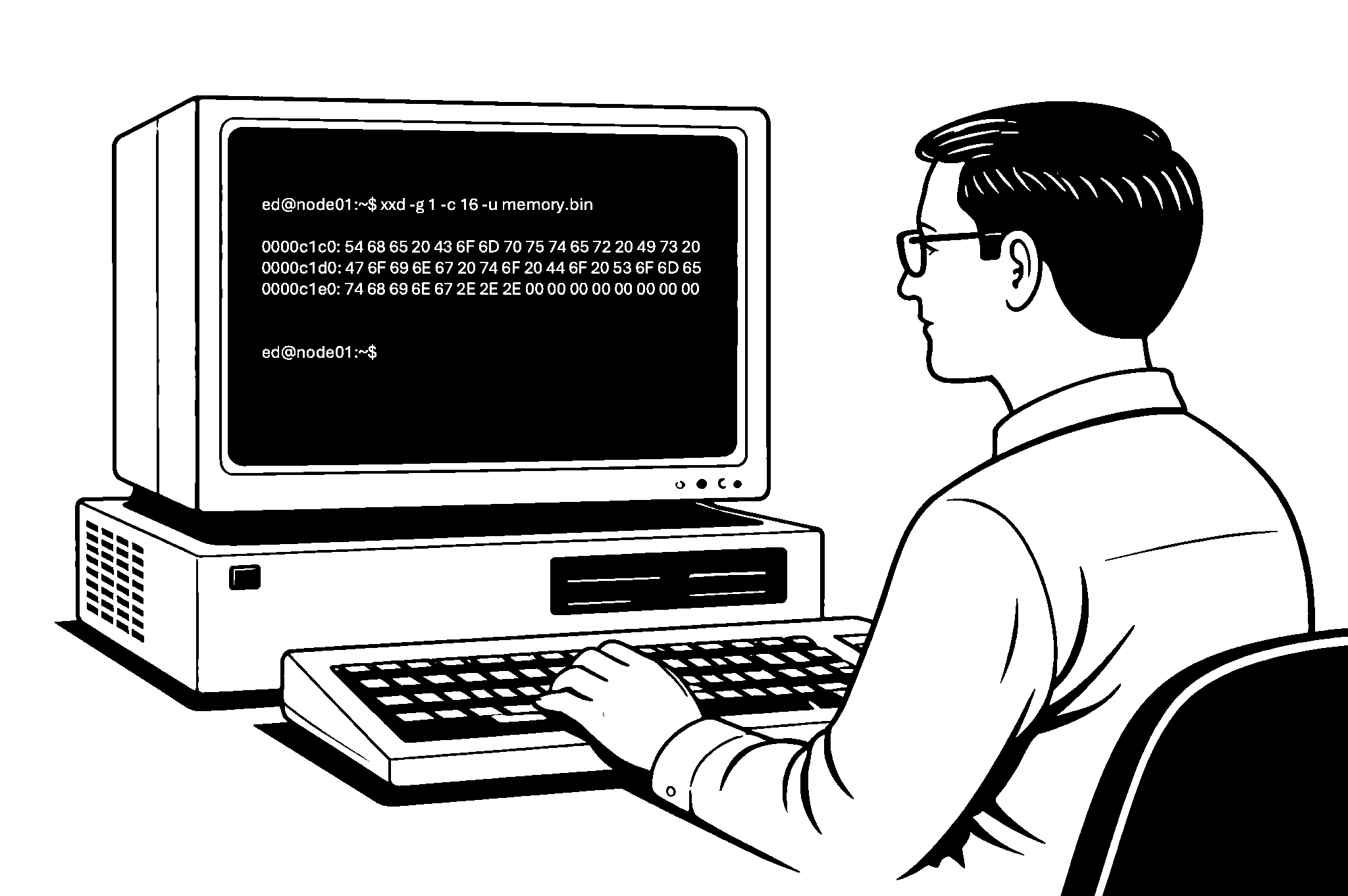
If you are not already familiar with Hello, World!,2 it’s widely regarded as the smallest possible initial declaration of intent in programming. It’s a single line of code that simply says, “I exist.”
A small invocation, certainly. But beneath that modest greeting lies something much larger. Because, for many, it is the first deliberate act of making a computer do something.
Not computation in the abstract. Not a computer sitting idle as a collection of circuits and silicon. A computer doing something.
When you write, Hello, World!, you are not merely printing text to a screen. You are asserting intent.
You are collapsing abstraction layers into action.
Transistors switch. Clock cycles gate execution. The instruction pipeline fills and drains. Branch predictors speculate. Cache lines evict and fetch. Page tables map virtual intent into physical reality. System calls cross privilege boundaries. Buffers mutate. The frame buffer is rewritten. Electrons move. Pixels change. Computation escapes the machine and becomes visible.
The machine responds.
In that moment, the computer shifts from potential to action. It stops being a general-purpose device and becomes a specific instrument of your will.
That is the real journey that begins with that first line of code. It is not about syntax. It is not about which language you choose. It is about learning to express intent with enough precision that a machine can execute it without interpretation.
For many of us, to make a computer do something is to accept a discipline where we:
- translate human intention into exact instruction;
- work within logical constraint;
- design cause and effect deliberately;
- evaluate what should be built versus what should be retired;
- anticipate failure;
- and own the outcome.
The computer will not guess. It will not adjust for ambiguity. It will execute what you specify, nothing more and nothing less.
Which is why that first line matters.
Because once you realize that a computer can be made to do something, the next realization follows quickly: it will do exactly what it is told.
Everything that follows determines what the computer is going to do.
- One program might print a greeting.
- Another might process payroll.
- Another might route aircraft, clear financial trades, control power grids, or coordinate global supply chains.
Every enterprise system, every platform, every architecture diagram eventually reduces to this simple fact: instructions execute, and outcomes follow.
The first line of code proves possibility. Everything after it is commitment to structure, to constraint, to causality, and to the outcomes that follow.
In our first article, How to Lead Enterprise Architecture: Balancing Long-Term Direction with Immediate Results, we begin at an intentionally high level. We explore how, as a technology leader, to create forward momentum without losing sight of today’s obligations, and how to start building the staying power needed to shape the future by making a computer do something.
The Computer Is Going to Do Something – Join an ongoing, practical examination of technology strategy, enterprise architecture, systems engineering, and technology operations.

Leave a Reply